
Sacred Stopping
We breathe out and then in

Find yourself a February where you can just stop. A hole in the ground to crawl into. A pause so that what you’ve been looking for all around the world can have a chance to come find you.
Every religion, every wisdom tradition, has a practice for stopping. Regularly. Pausing. Whether it’s sabbath or shabbat or rāhui.
Rāhui is a Polynesian resource management practice embedded in epistemologies of interrelatedness; a ritual prohibition of an area or resource for purposes of conservation, replenishment and sacralization. I engaged the concept in my master’s thesis, which I presented on a panel alongside a theologian I’d later meet again in his home country of Samoa.1 Driving slow on a Sunday with this Samoan theologian -- he tries not to drive on Sundays, but if he does it will be at 20 miles per hour -- he talked to me about the spiritual ecology of rest. He told me that if they didn’t move slowly on his island, if they didn’t stop on Sundays and let the lands and oceans and body rest, they wouldn’t survive. It’s an island. Ecology is survival. And it’s sacred.
If fields didn’t fallow we’d have nothing to eat. If we didn’t sleep we’d break.
We all know the relentlessness of capitalism, how it seeks to fill every space. That when they discovered they could fit it into our pockets to frack us2 constantly - fairly recently in human history - there was no escape.
I wrote about this a while back, but more in terms of the disconnection social media enacts when our climate crisis calls us to reconnect:
As children of both the climate crisis and social media, we were called into our reconnection at the same time that we were inducted into our newest separation, ourselves from ourselves as profiles, as data points, enriching the likes of men who can buy up sacred islands where the people are still singing, resisting, and co-creating.
- “Internet Grief: Where the Island Meets the Metaverse” - published in The Journal of Wild Culture and republished in Resilience (originally written for a graduate seminar with Naomi Klein!)
I’ve always been aware of the violation, but that wasn’t enough for me to stop the addiction. I’ve been anguished, for so long, by my addiction to social media; I have no way of guessing how much of me, my life, my friends, it has stolen.
“I feel like social media is a party drug that we all started taking 10, 15 years ago in big doses. It was like, this is so fun. And now we're all addicted to it, and no one's getting high off it anymore. It's just maintenance.”
I quit recently. A friend3 formed a support group, we met on Zoom, he showed us a little PowerPoint reminding us how bad social media is, and we all made our own commitments. I didn’t quit completely, but I went back to a restriction I first devised when I was 17, when I was still early in discovering how bad for me this was, when I was trying to intervene in an addiction no teenager should be subjected to. I didn’t even have a smartphone yet then.
In the Zoom support group, we came up with ideas for what we could do instead of scrolling. I decided that I’d write haikus on the toilet, when I’d otherwise scroll. (Haha.) My finger hovered over the Instagram button and struggled to open a blank page instead.
It didn’t take long for what dwells in the stillness to find me. Look — see for yourself — in these bathroom-jotted fieldnotes of sorts, in haphazard haiku form, from my first few days of “quitting” social media.
My first time writing
A haiku on the toilet
Is not so easy
-
But I try again
It’s just a new skill to learn
A habit to break
-
Directness of life
The mind returns to its pace
It’s quieter here
-
It’s a home rhythm
A natural frequency
Gentle inner hum
-
So many other
People’s songs vying for me
I need my own voice
-
Streaming images
Flat portfolios on screen
Two dimensional
-
War of attention
They can take everything
But they can’t take this
-
The mind a prism
Lifetimes still in the making
A precious treasure
-
The competition
Was breaking my will to be
I didn’t want it
-
The comparisons
A constant assault blazing
When I love my friends
-
Love is important
It lives in the quietness
Humming inside us
-
I hear it now in
My precious prism mind when
The rushing is stilled
-
I reach for the scroll
Then I stop and try to write
Inside out it streams
-
We forgot how to
Listen to our own quiet
How to be this still
-
The flowing fountain
Constant splashing stimulus
Searching for dry land
-
Money hidden in
Algorithms hidden in
Flashing images
-
The palm of my hands
Folded around the capsule
The vortex of need
-
I bleed digital
I cry like a scrolling stream
My throat is empty
-
My electronic heart
My screens, my eyes, my coding
Quiet now, flowing
-
It’s lonely when you
Switch off the town square and find
The quiet of you
-
Distractions from all
Your own life has been trying
To whisper to you
-
If a phone dies does
Anyone hear it? Or do
I need to post it
-
The news is streaming
In memes, our commentary
When sense is slipping
-
Is reality
Bendable to our screening?
Or is it hidden
-
I find a world that
I was always meant to live
In. A world hidden.
-
The song barely has
Words yet we have all been forced
To memorize it
-
We don’t need to think
If the algorithm thinks
So efficiently
-
It’s too quick now to
Stop. It’s too fast now to hide.
We can’t be found here.
-
Find yourself a beach
Where the waves are pulled by moon
Unspool your needs here.
These “toilet haikus” are heading towards a recollection of a time when I first “stopped.” After graduating college, I found myself on an island where — not intentionally — I finally truly stopped, for the first time in so long, after a youth of overperformance.
We were just falling
In love with reality
We were just healing
-
A bunch of lost kids
Clinging to the edge of cliffs
Barefoot in a dream
-
Earth beating beneath
The dirt, we were learning to
Play its music
-
May all children of
Creation find their mother
In the milky way
-
May the shore still beat
Against sand, against cliffs and
May we tremble too
To put it plainly, after graduating with high honors and straight As, after graduating with a near perfect IB score, after a burgeoning youth too devoted to the ritual curating of an excellent resume to launch breathlessly into the pursuit of nonstop success (thankfully braided with a love of learning) —
I flew to an island to volunteer on an organic goat dairy farm.
I sat before the ocean on my first day and what immediately happened was:
“What is this I’m feeling?” I looked at my hands, as though to check they were still there. The unnamable feeling shot through me icy, like my blood filled with a new substrate. Crystals of a sort. “Ecstasy?” I tried.
It crashed over me. I was a dot in the sand, but also infinite like stars. Waves exploded, blinding.
Whatever it was, this new substrate, it made decisions for me. I didn’t have to think. I said it out loud to Joe, stupefied: “I think I’m going to stay here a lot longer than I planned.”
-Excerpt from my autofiction manuscript
When I say that the climate crisis, or metacrisis, calls for resacralization, this is partly what I mean. The need to stop to allow us to receive. That inhalation, so we’re not constantly exhaling, blowing our breath everywhere. That stillness, to let the ocean of life speak.

I’m emerging now from a still February. It wasn’t planned that way. I was supposed to spend February on a major project, which dramatically fell through, which left me unexpectedly alone with myself. Finally.
So I found a writer’s residency in a quiet forested village on the river in upstate New York. I didn’t have a car, which means my only activity options outside of myself were snow-crunching walks along the frozen river, and a few cute local businesses, like a general store and a speakeasy bar in an antiques shop only open on weekends. A Wes Anderson vibe, unexpected.
When I first arrived though — after a fairly traumatic experience on the other side of the world, to be honest with you — I immediately freaked out. “There’s nothing to do here!” Fight or flight was my first response. Then I took a hot shower, brewed a cup of maple ginger tea, lay back in bed, and within an hour overjoy found me. “There’s nothing to do here!!” I sat at my desk, staring out at a library, a too-large American flag, and a small corner of the frozen river, and started writing.
The month is ending now, as I write this, and I can tell you that it has felt like steeping back into the ocean of myself. Everything I hadn’t been able to hear. All that had been drowned out by the movement and noise. All that I’d been looking for.
The emptiness I’d tried to fill in pursuing that major project that fell through? It filled, again, in stillness. In my own silence. I didn’t need to go look. I needed to stop.
So too with the earth, is what I’m saying.
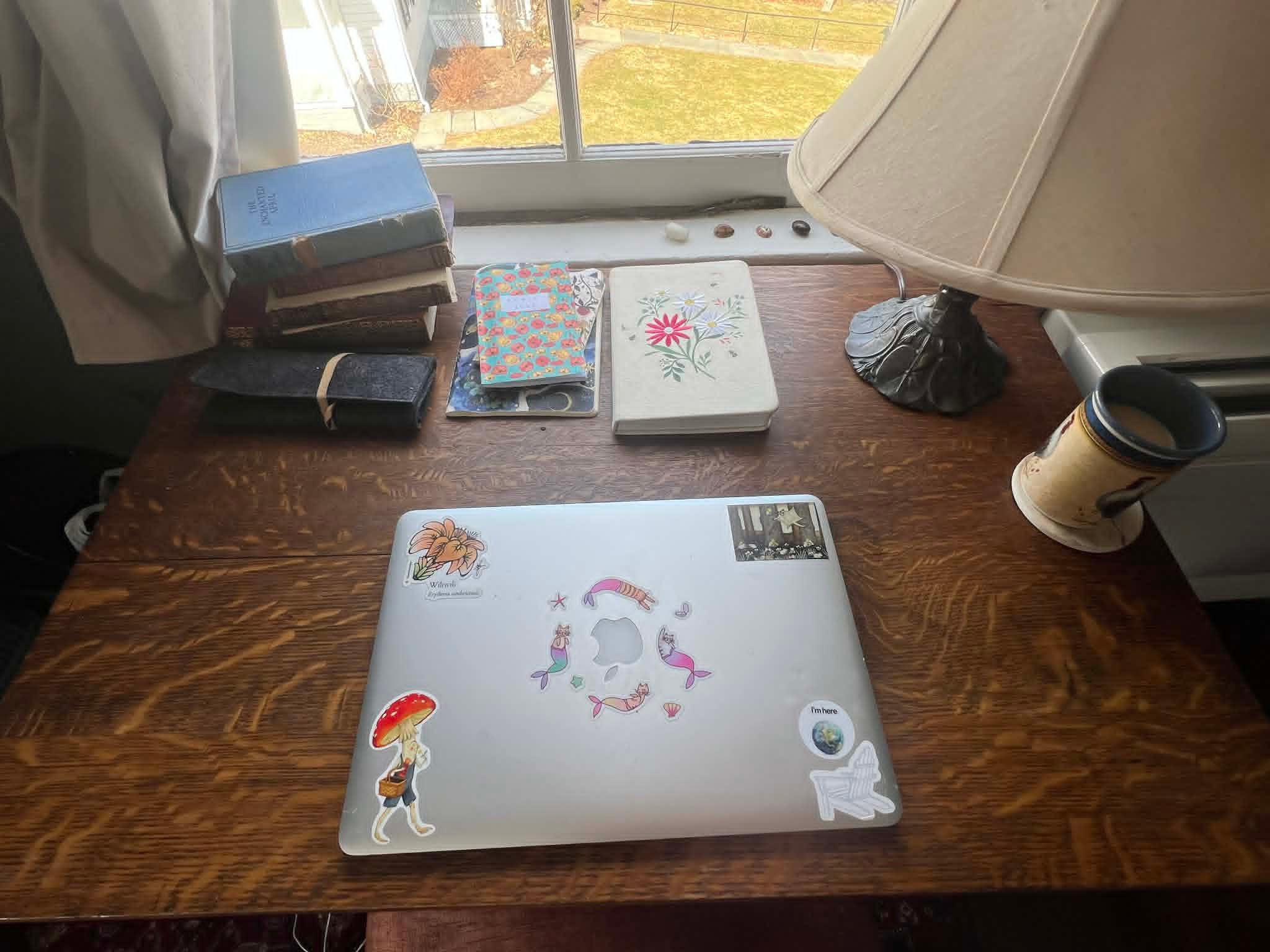
Find yourself a still February. Or a weekend where you can put everything down. Or an hour each day where you don’t check your phone, or a time each evening where you turn it off. Or a moment where you wake up alone with your silence. Or a walk with the quiet. Whatever you need, whatever you can fit, whatever in-breath you can take, for the space to just listen, to make yourself sacred.
My residency ends tomorrow, and I take a train to the city to get on a flight to a different continent in a couple weeks. I was feeling anxious about this, unwilling to leave my wintering, but now the sun is shining and we’re starting to spring. The river unfreezes. The final icebergs float downstream. Soon the trees will flower and we’ll be able to see the greatest beauty of the year, what it took a wintering to prepare.
Rev Dr Brian Fiu Kolia
Great term engaged in Attensity!: A Manifesto of the Attention Liberation Movement by The Friends of Attensity, who I met in New York
Shout out to the great Daniel Labov Dunne!
Thank you Sadie. 🫶🏿